


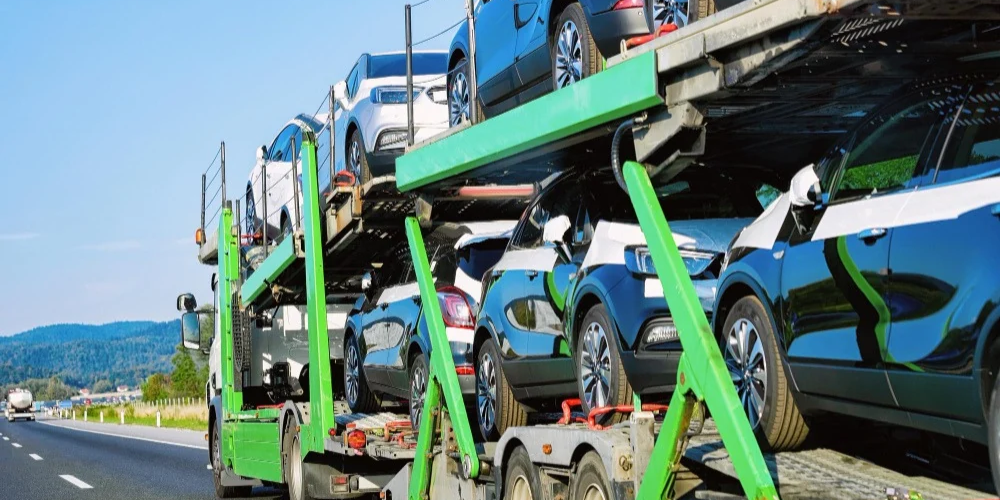

Most supply chain visibility software was built to track shipments. It tells you a container or a railcar moved. Finished vehicle logistics needs something more precise, which car is where, in what condition, right now. Supply chain visibility software for finished vehicles must work at the level of the individual vehicle, tracking each one by VIN across every partner in the chain.
A container is a sealed box. Seal it, track the box, and the contents look after themselves until it is opened. A finished vehicle is a different kind of cargo altogether. It is driven, parked, inspected, repaired and modified, and it is exposed to damage at nearly every stage. Each car carries its own identity in its VIN and its own record of what has happened to it.
Shipment-level visibility tracks the movement of a consignment. It can tell you a railcar left a terminal. It cannot tell you which of the vehicles on that railcar has a quality hold, which is waiting on a charge, or which arrived with a scratch that will become a claim. For a supply chain control tower to show the true state of the operation, the data underneath it has to be per vehicle, not per shipment.
Visibility at the vehicle level rests on three things travelling with every VIN, which are location, condition and status. Location is where the car physically sits, down to the yard and the bay. Condition is its recorded state, captured through mobile inspections and surveys with AIAG damage codes and photographs at each handover. Status is where the vehicle stands against its plan, whether it has cleared inspection, completed its Workshop work or been released for dispatch.
None of that comes from a tracking screen on its own. It is captured on the ground, as the car is moved, inspected and processed, then read against a known end-to-end plan. Visibility only means something when it is related to that plan, so the system can tell you where a vehicle is and whether it is early, late or in the wrong place.
A finished vehicle passes through many hands, and each partner tends to see only what is in front of it now. A quality inspector judges the car in front of them, not how it looked at the last checkpoint. A carrier knows its own leg. The value of visibility software is that it holds one continuous record across every checkpoint, so a vehicle's full history travels with it rather than resetting at each handover.
Those updates arrive through integration, not from the car itself. Carrier integration brings partner data in automatically through electronic data interchange and APIs. Where vehicle telematics is available, it is supplied by the OEM and carries more than position, including battery charge and tyre pressure, each a signal the platform can read in context and act on. The vehicle is not sending a raw feed to the platform. The platform is interpreting OEM-supplied signals against the vehicle's place in the process.
Platforms built for pallets and containers will not deliver this. They were designed to track consignments through a network, and they have no concept of a car in a bay, a dwell clock on an individual VIN or a damage record tied to one vehicle. Point one at a finished vehicle operation and it will show you shipments moving while the questions that matter go unanswered.
An aggregate dashboard has the same weakness. A single live view across the whole network is useful, but it can only be as accurate as the per-vehicle data beneath it. Without truth at the level of the individual car, a dashboard is a confident-looking summary of information nobody can stand behind.
Finished vehicle logistics needs visibility at the level of the single vehicle, because that is the level at which the work happens. ProAct Global Solutions captures that data on the ground, through enterprise vehicle yard management and mobile inspections and surveys, and carries it across every partner so the record stays continuous from factory to dealer or direct to the customer. If shipment-level tracking is leaving you guessing about individual cars, speak to our team about visibility built for finished vehicles.