


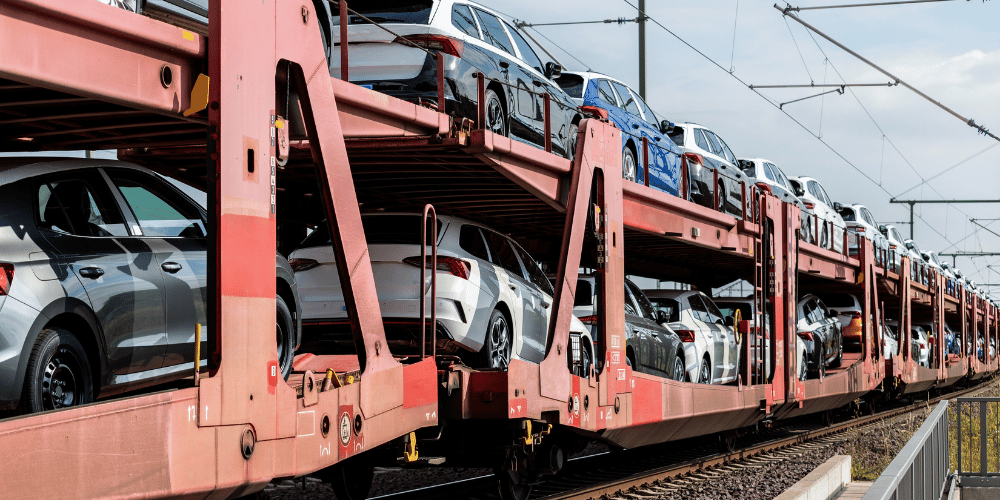

When it comes to delivering a finished vehicle, it's rare for it to travel the entire journey using just one mode of transport. Typically, it starts its journey on the road, hops onto a train or a short-sea vessel to cross a region, sails across oceans, and finally makes its way back on the road to reach the dealer or the customer's doorstep. Each of these transitions represents a handover, and with every handover comes the risk of a vehicle going off the radar, getting delayed, or suffering unnoticed damage. This is the crux of finished vehicle logistics, and it's precisely why maintaining visibility throughout the process is such a challenge. The mix of transport modes is unavoidable. What truly matters is the platform that supports it all.
In most supply chains, you'll find one dominant mode of transport. However, that's not the case with finished vehicle logistics. Transporting a car from the factory to the customer almost always involves a sequence of different modes, making this the norm rather than the exception. A vehicle might be driven onto a car-hauler right at the plant, then loaded onto railcars for the lengthy inland journey, transferred to a Pure Car and Truck Carrier (PCTC) or a Roll-on/Roll-off vessel for the ocean crossing, and finally handed over to a regional carrier for the last leg of delivery.
Each segment of this journey is managed by a different operator, often using separate systems, with the vehicle changing hands at various compounds and ports along the way. The original equipment manufacturer (OEM) or logistics service provider overseeing this flow needs to keep track of every vehicle's location and condition at each of these points. The more modes and operators involved, the more handovers there are, and the greater the chances of losing track of the vehicle.
You might hear these two terms tossed around as if they mean the same thing, but they actually refer to different concepts, and understanding this difference is crucial for effective vehicle network planning.
Intermodal transport involves keeping cargo in a single sealed unit, usually a container, that can move across ships, trains, and trucks without the goods inside being handled. On the other hand, multimodal transport refers to a journey that spans multiple modes of transport, all managed under one coordinating responsibility, regardless of how the cargo is packaged.
When it comes to finished vehicles, the process is predominantly multimodal. While a small number of cars are shipped in containers, most vehicles are driven or loaded and unloaded at each mode transition, with inspections and records created at every step. This means that the vehicle itself is physically handled each time it changes mode, making it essential to track the condition and custody of each vehicle throughout the journey. That's why a finished vehicle network needs to be meticulously planned and monitored on a vehicle-by-vehicle basis, rather than treating them as sealed units that just pass through.
When road, rail, and ocean transport operate on their own isolated systems, the data flow gets interrupted at the boundaries between them. A rail system might know everything about the rail segment, but it has no clue about what happened before or after. Similarly, a yard system only sees its own area, and nothing is beyond that. Each time information is handed over, it often must be re-entered, exported, or emailed, and these breaks in communication are where updates go stale, and accountability slips away.
Even generic supply chain platforms don't bridge this gap effectively. They were designed for moving pallets and containers, not for tracking individual vehicles by their VINs across various locations like plants, railheads, ports, and yards. Single-mode and generic systems can't deliver visibility across a multimodal operation because they weren't built to handle data beyond the specific mode they cater to. This fragmentation leads to a disjointed view, which is exactly what causes vehicles to go out of sight at critical handover points.
The key is to streamline every mode of transport through a single, adaptable platform instead of juggling a mix of separate systems. When road, rail, and ocean all funnel into the same system, data flows across each transition, keeping location, condition, and status consistent from the plant all the way to final delivery.
In real terms, this means that transport management software and freight management are all working off the same data as the yard, the railhead, and the quayside, brought together through carrier integration. You can see railcar movements, vessel tracking with live GPS positions and estimated times of arrival and the final road delivery tracked by vehicle telematics, all in one unified view. ProAct Global Solutions has created this within a convergence ecosystem, where automated, real-time data from every mode is integrated, allowing the network to function as a cohesive operation rather than a series of disconnected segments. This is what supply chain orchestration looks like in finished vehicle logistics: every mode is planned, executed, and tracked from a single configurable platform that can adapt as routes and modes evolve.
The complexity of multimodal logistics is a defining feature of finished vehicle logistics, and the operators who excel are those who orchestrate this complexity rather than simply endure it. By treating road, rail, and ocean as a unified network instead of a collection of isolated challenges, every vehicle remains visible from the factory to its final destination.
That's exactly what ProAct Global Solutions has developed. Our platform is built on the convergence ecosystem, with the orchestration engine and process digitalisation engine at its heart, linking every mode into a single configurable system tailored to the realities of finished vehicle logistics. If you're looking to unify fragmented, mode-specific operations into one clear view, reach out to us.