


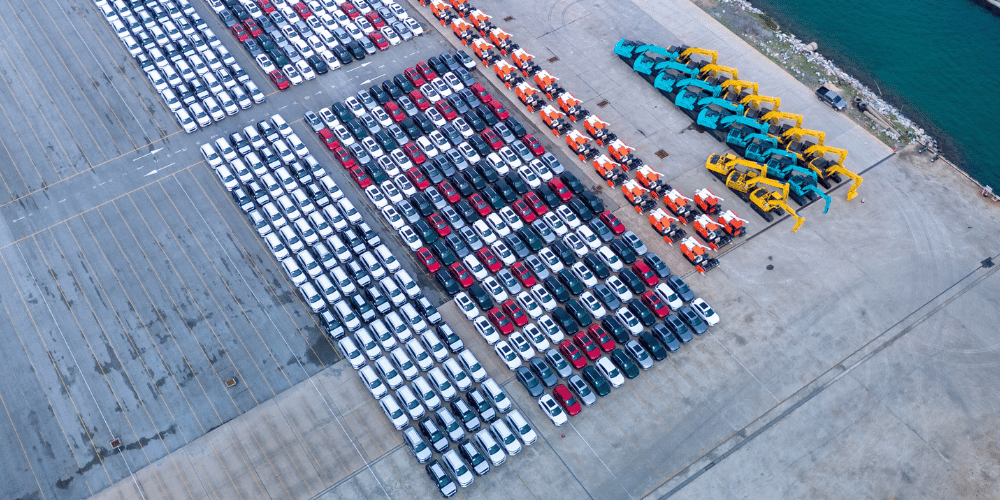

Finished vehicle logistics is shifting to shorter, faster, more regional routes. OEMs are moving production closer to the markets they sell into, the long ocean voyages that defined the sector for decades are breaking up, and a single vehicle now passes through more handoffs before it reaches the dealer or the customer. Each handoff is a point where a vehicle can sit too long, end up in the wrong bay, or take on damage that goes unrecorded until a claim lands. The challenge now is keeping track of every vehicle across a network that is constantly moving.
For years, finished vehicle logistics followed a long, predictable path. A vehicle manufactured in one region would spend weeks on an ocean car carrier before reaching its market. That pattern is starting to shift. To avoid tariffs, navigate geopolitical uncertainties and reduce lead times, OEMs are relocating production closer to where the demand is, specifically in Central and Eastern Europe, Mexico and Turkey. The reasoning is clear: with the US imposing a hefty 25% tariff on imported vehicles, building closer to the customer often makes financial sense.
As production becomes more localised, the transport network is evolving alongside it:
- There's a noticeable shift from long-haul ocean routes on Pure Car and Truck Carriers (PCTCs) towards a mix of rail, short-sea shipping and road transport
- Ports are getting busier, and storage compounds are filling up as direct exports flood into these hubs
- Capacity is tightening on specialised Roll-on/Roll-off (RORO) vessels and car-hauler trucks as routes adapt
- Increasing pressure to decarbonise outbound logistics, made easier by shorter distances and now monitored under Scope 3 reporting
A vehicle might pass through five or six different operators before it reaches its final destination, and a network with that many moving parts leaves little room for anything to go wrong unseen.
Most finished vehicle operations have been designed to be reactive. A vehicle arrives, someone records it, and the next move happens when a person gives the go-ahead. This system works fine when volumes are stable, and routes don't change much. But it starts to crumble in a network that shifts week by week.
You can already see the pressure mounting. Direct exports are flooding into crowded ports, RORO and car-hauler capacity is stretched thin, and operators are resorting to moving cars in containers just to keep deliveries on track. According to McKinsey, the cost of supply chain disruptions can eat up 45% of a year's profits over a decade for the average business. In this industry, that translates to vehicles sitting in compounds far longer than expected, staff wandering the yard trying to locate a car that's gone missing in the system, and damage that only comes to light as a dealer's claim weeks down the line.
Standard supply chain software can't handle this. It was designed for moving pallets and containers, not for tracking individual vehicles by VIN across plants, rail, ports, and compounds. It won't tell you which vehicle is parked in which bay, how long it's been there, or what condition it's in right now. That leaves planners working from yesterday's data and yesterday is no longer good enough.
Real-time supply chain visibility is all about having instant access to the location and condition of every vehicle, right when you need it, not just at the end of the day. That view runs the full length of a finished vehicle network: plant, rail, short-sea, port, compound, and the final leg to the dealer or directly to the customer. Achieving it means capturing data automatically at each handoff, whether through vehicle telematics or direct carrier integration, then rationalising, validating and standardising that information so every team works from the same accurate overview.
At the heart of this network is a supply chain control tower that oversees and coordinates everything, but its effectiveness hinges on the quality of the data it receives. That data is captured on the ground. Enterprise vehicle yard management tracks which bay each vehicle occupies and logs every move it makes, so compounds are no longer places where vehicles quietly go missing. Mobile inspections and surveys captures each vehicle's condition at every checkpoint, so damage is reported the moment it happens rather than weeks later when the dealer gets involved. ProAct Global Solutions built both to feed the control tower real-time, accurate data, because the layer above is only ever as dependable as what reaches it.
Understanding the network is only half of the battle. The real value comes when you can act on what you see, and that is where automation steps in. Once live data is streaming in, the platform can do what no team could ever manage quickly enough:
- Spot a delay as it starts to develop and flag it before it escalates, using process prediction algorithms and AI agents
- Simulate an alternative route in a supply chain digital twin before any vehicle is assigned to it
- Push the updated plan across rail, road, sea and yard through the orchestration engine
This is what supply chain orchestration looks like in action: proactive decisions instead of scrambling to put out fires. People are already used to tracking a parcel right to the door in real time, and a customer waiting on a vehicle expects nothing less.
The same data also helps with emissions. Shorter regional routes cut carbon on the outbound leg, and rules like the CSRD require OEMs to track and report Scope 3 emissions. The automated capture behind real-time visibility generates that reporting as a by-product, so one system handles both control and compliance.
Real-time, automated visibility has moved from a competitive advantage to the essential standard for running a finished vehicle network. The divide between operators who have it and those who do not widens every time trade routes change. Generic platforms were never meant to bridge that gap, but software built specifically for finished vehicle logistics can.
ProAct Global Solutions built its enterprise control tower on the convergence ecosystem, with the process digitalisation engine at its heart and our enterprise vehicle yard management and mobile inspections and surveys feeding it live from the ground. We built it for this industry and the conditions reshaping it today. If you are working out how to keep your network together as it changes, get in touch with our experts today.