


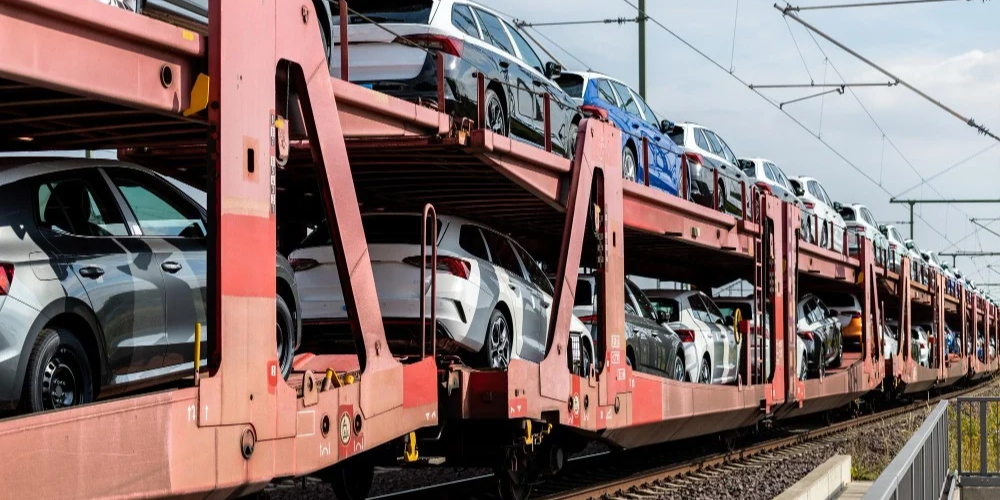

Nearshoring is changing how finished vehicles move. As production shifts closer to demand and OEMs look for alternatives to long road hauls, more cars are travelling inland by rail. Rail logistics software for finished vehicle distribution must coordinate that leg precisely, across railcar movements, railhead handovers and railcar inspection, so vehicles stay visible and in condition as volume moves onto the network.
Supply chains are regionalising. Production is moving closer to the markets it serves, tariffs are reshaping trade flows, and inland corridors are carrying more of the journey that once sat on long ocean routes. Rail is the natural beneficiary. It moves large volumes between ports and inland distribution hubs at lower cost per vehicle and lower emissions per tonne-kilometre than road.
The detailed case for real-time visibility through nearshoring and trade shifts sits in a separate piece. The point here is narrower. More rail means more rail-specific demands on the software that runs the network.
The rail leg is not a single movement. It is a sequence of controlled transfers, each a point where a vehicle can lose visibility or pick up damage. Cars are loaded onto railcars at origin, moved along the corridor, then unloaded at a railhead and handed to a compound or an onward carrier. Every one of those transfers needs custody and condition recorded against the VIN, rather than a railcar number.
Rail also brings its own asset to manage. Railcars need inspection and maintenance, and below-deck repair keeps them in service. Our railcar inspection application replaces paper with digital job tracking, so repair tasks are logged, categorised and actioned without a car or a wagon waiting on a clipboard.
Coordinating rail starts with integration. Rail carriers run their own systems, so the software must connect through electronic data interchange and modern APIs to pull railcar status in automatically rather than by phone and spreadsheet. ProAct Global Solutions has more than thirty years integrating ocean, rail and road carriers, and that shows in how carrier integration handles the variety of partner systems on the rail leg.
From there, the platform schedules and tracks railcar moves and runs rail yard cargo management at the railhead, so loading, unloading and storage are controlled rather than assumed. Each movement feeds the yard and the Control Tower in real time. The rail-to-yard handover, usually a blind spot where a vehicle drops off the radar, becomes another tracked step in one continuous record.
Rail rarely runs end to end. It sits between an ocean crossing and a final road delivery, or between a plant and a port. If the rail system only knows the rail segment, the network breaks at each boundary, and the vehicle resets to unknown every time it changes mode. Rail has to be planned and tracked as one leg of a multimodal vehicle transport network, on the same platform as road and ocean. When it is, condition and status carry across the rail-to-road or rail-to-ocean transition instead of starting again, and planners keep one view of where every car is and what state it is in.
Rail is becoming a bigger and more demanding part of finished vehicle distribution, and the software must treat it as more than a line on a route. Rail yard cargo management, railcar inspection and carrier integration all sit inside our wider Finished Vehicle Logistics platform, so the rail leg is planned, tracked and recorded alongside every other mode. If nearshoring is putting more of your volume onto rail, speak to our team about handling it on one platform.